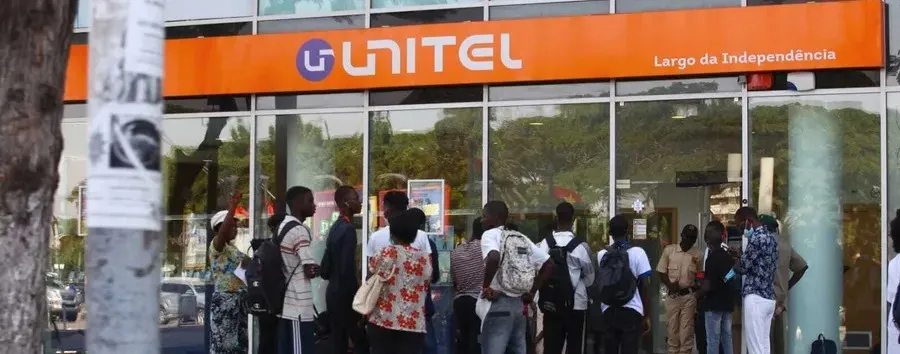
Angola’s largest telecommunications operator has entered a second day of severe disruption following a cyberattack that affected voice calls, mobile data and internet access across the country.
With approximately 21 million customers, Unitel carries the most significant share of Angola’s personal, business and institutional communications. The network outage has left families unable to reach one another, disrupted internet-dependent businesses, hindered payments and commercial transactions, and affected ride-hailing services and numerous other daily activities.
The losses have yet to be calculated, but the economic and social impact is already apparent. Every hour of disruption means interrupted business, lost customers, suspended transactions and employees unable to work normally.
In a statement issued on July 28, Unitel said the attack had been detected at 2.20am. The company said its response and containment mechanisms had been activated immediately and that its technical and cybersecurity teams were working to mitigate the effects of the incident and restore services in full.
Sources familiar with the situation told Maka Angola, however, that Unitel’s CEO, Amílcar Safeca, was awaiting the urgent arrival of foreign specialists to resolve the crisis. According to the same sources, the company lacks the internal expertise required to restore all the affected systems.
The country of origin of the specialists and their expected arrival time in Angola are being kept confidential. Unitel has also yet to disclose the nature of the attack, the full extent of the damage, whether customer data may have been compromised or when services will be fully restored.
The seriousness of the incident is heightened by the fact that Unitel was under the complete control of the Angolan state.
Half of its share capital was held directly by the state through the Institute for the Management of State Assets and Holdings, or IGAPE. The remaining 50 per cent was controlled indirectly through the state-owned oil company Sonangol and its subsidiaries.
IGAPE’s stake includes the 25 per cent previously held by Vidatel, a company owned by Isabel dos Santos, and the 25 per cent formerly held by Geni, which was linked to General Leopoldino Fragoso do Nascimento, widely known as “Dino”. President João Lourenço nationalised both holdings in October 2022.
Although the legal proceedings connected to those holdings have not resulted in final judgments, the state proceeded with a public offering of 15 per cent of Unitel’s shares. The transaction brought to market shares derived from an ownership structure whose definitive legal status remains open to question.
The cyberattack occurred on the eve of Unitel’s scheduled listing on Angola’s stock exchange. The timing makes transparent disclosure about the company’s security, the losses it has suffered and the risks facing its new shareholders more urgent.
The crisis also highlights the decline of Movicel, which should have provided a domestic alternative in the event of a major Unitel outage.
After the state assumed majority control of the operator, including through confiscated shareholdings, Movicel entered a prolonged financial and operational collapse. The company is technically insolvent, lost almost 80 per cent of its subscribers between 2021 and 2025 and ended last year with just over 300,000 customers.
Its network is now barely operational in many parts of the country. Movicel can therefore no longer provide a viable alternative for the millions of Angolans affected by the disruption to Unitel’s services.
Angola has three mobile operators, but the third option, Africell, operates in only six of the country’s 21 provinces. Its limited geographical reach means that it cannot provide a nationwide alternative or resolve the underlying concentration of the market.
The result is a dangerous concentration of risk. Although Angola formally has three mobile operators, Unitel has become so dominant that its paralysis immediately affects much of the country and a large part of its economic activity.
The World Bank has described Angola’s mobile market as operating, in practice, as a duopoly. Yet even that description understates the country’s exposure. Movicel is barely functioning, while Africell lacks nationwide coverage. For millions of Angolans, there is no effective alternative to Unitel.
The decline of Movicel and Africell’s restricted footprint have deprived Angola of the redundancy needed to protect the country against technical failures, sabotage or cyberattacks.
The Unitel incident is more than an outage at a mobile phone company. It reveals the fragility of strategic infrastructure on which millions of citizens, businesses and public institutions depend.
If the country’s largest telecommunications company can be disrupted on this scale and must rely on foreign specialists to restore its systems, how resilient are Angola’s other critical institutions in the face of a co-ordinated attack?
The same question must be asked of the banking system, electricity networks, civil identification services, tax and customs administrations, hospitals, airports, defence and security institutions, and state databases.
The attack on Unitel is a national warning. Angola must establish its true capacity to prevent, detect and respond to cyber threats, as well as the extent to which it depends on foreign expertise when its critical infrastructure comes under attack.
Silence and a lack of transparency do not protect the country. They merely conceal vulnerabilities that a potential attacker may already be exploring.