França
 Espanha
Carrinho: The Sanctions Shadow Behind Angola’s Industrial Showcase
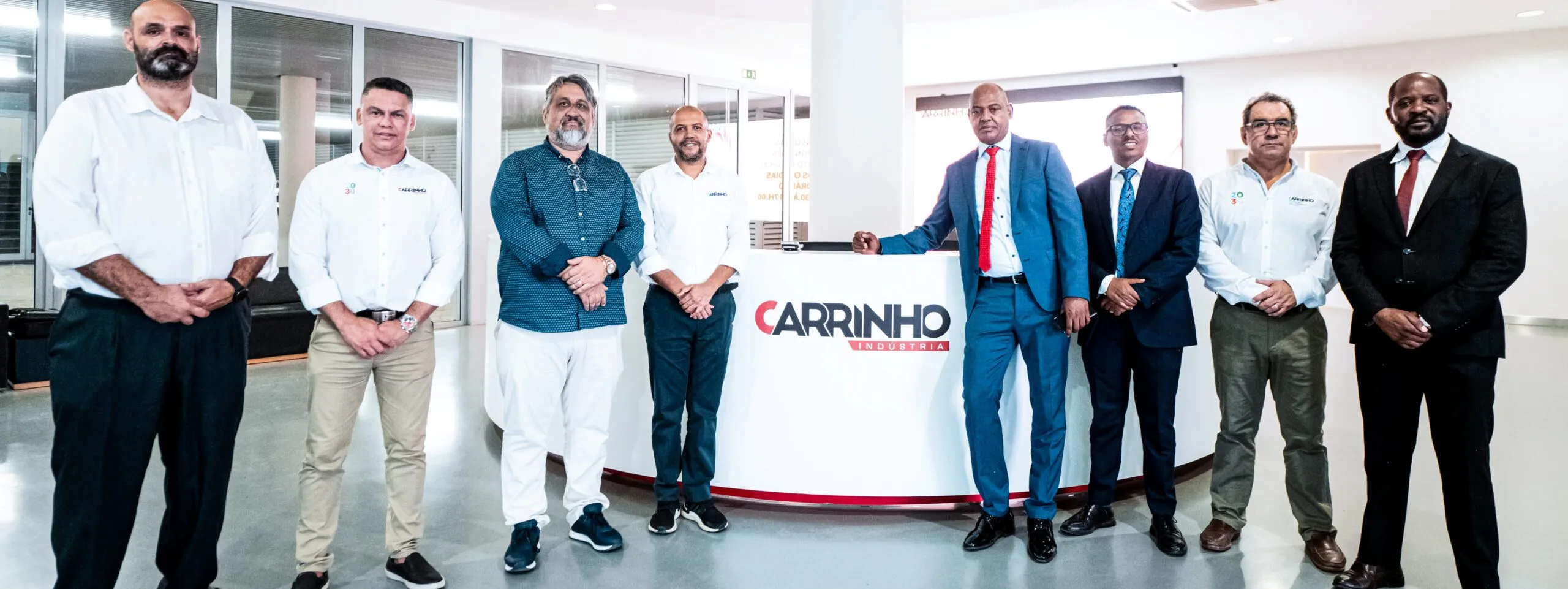
Angola’s most celebrated industrial project was financed in part by a trader later sanctioned by the European Union and the United Kingdom. There is no proof of wrongdoing by Carrinho — but the absence of transparency leaves troubling questions unanswered.
After examining how public contracts and sovereign guarantees have concentrated economic power in Angola (see the first part of this dossier), this second investigation looks at the international ties of the Carrinho Group — including partnerships with entities linked to sanctions proceedings in Europe — and the due-diligence and transparency questions that follow.
Carrinho’s business relationships with several international entities warrant heightened scrutiny, particularly given the lack of publicly available financial information and the complexity of the corporate structures involved.
Confirmed links connect Carrinho to Manty AG, based in Switzerland and led by Maurice Taylor, and to Paramount Energy & Commodities, founded by Dutch trader Niels Troost.
Manty AG appears to function as a trading intermediary for Carrinho’s food imports. Several sources suggest that Manty may in fact be controlled by Carrinho itself, though this is not publicly documented.
Manty’s website previously described Carrinho as a “partner,” without clarifying the nature of that relationship. A 2026 redesign of the site is less explicit, though it continues to reference Carrinho in more subdued terms.
The absence of public financial disclosure regarding Manty’s relationship with Carrinho has fueled speculation in Angola’s press about how import pricing and financial flows may be structured.
A second company closely linked to the group is Paramount Energy & Commodities, which contributed US $70 million to the construction of the Carrinho Industrial Complex, inaugurated in 2019 in Catumbela by President João Lourenço.
The investment was widely promoted as a milestone in Angola’s industrial development. Yet the financial details of the partnership between Paramount and Carrinho have never been fully disclosed, leaving unanswered questions about the origin of the funds and the conditions of the investment.
The central figures associated with these companies are Maurice Taylor (Manty) and Niels Troost (Paramount).
Taylor was described as an “associated individual” of Troost in the context of investigations into schemes aimed at circumventing sanctions imposed on Russian oil. On April 4, 2025, Taylor filed an action for annulment before the Council of the European Union, arguing that his name had been improperly mentioned in identifying information related to Troost in EU restrictive measures linked to Ukraine’s territorial integrity. Although Taylor himself was not sanctioned, he appeared as an “associated individual,” which he argued caused reputational and professional harm. The court declared the action manifestly inadmissible and ordered him to pay costs, because in the meantime Taylor had already been removed from the list.
Troost, a Dutch citizen and commodities trader dealing in oil and grains, was designated by the European Union on December 16, 2024, under sanctions related to Russia’s aggression against Ukraine. The decision, published in the EU’s Official Journal and later corrected, imposed financial sanctions, a travel ban and his inclusion on the list of restricted persons, effective April 9, 2025.
British authorities also listed him under reference RUS2086 pursuant to the Sanctions and Anti-Money Laundering Act 2018.
According to the European Union, Troost’s company, Paramount Energy and Commodities SA, transferred Russia-related operations to its Dubai subsidiary, Paramount DMCC, which allegedly traded Russian oil above the $60-per-barrel price cap imposed by Western governments.
Troost, who currently resides in Switzerland, is believed to be the first EU citizen sanctioned for involvement in Russian commodities trading under such conditions.
In statements to the Financial Times, Troost disputed the designation and claimed he was the target of a deliberate campaign led by his former business partner, Gaurav Kumar Srivastav.
Both Taylor and Troost have emphatically denied any wrongdoing.
None of this proves direct involvement by the Carrinho Group in circumventing British or European sanctions. But it raises legitimate questions about the level of due diligence and scrutiny applied to its international partnerships.
The irony is difficult to ignore. Carrinho was publicly highlighted by President Joe Biden as a symbol of Angola’s economic progress and renewed U.S.–Angola partnership. Yet one of the major financiers of its flagship industrial complex was later designated under European and British sanctions regimes linked to Russian oil trading.
The sanctions were public. The reputational risks were visible. The question is not whether Carrinho violated sanctions — there is no evidence of that — but whether sufficient scrutiny was exercised before celebrating the company as a model of transparent industrial partnership.
Taken together — the absence of public financial accounts for the Carrinho Group, the opacity surrounding Manty and Paramount’s financial structures, the personal and business links between Taylor and Troost, and international references to sensitive operations in the energy sector — these factors create fertile ground for speculation.
There is no evidence that the Carrinho Group is engaged in irregular practices or sanctions-evasion mechanisms. But in matters involving public contracts, sovereign guarantees and presidential endorsement, opacity is a serious risk.
Editor’s Note
Following publication, we received correspondence from Maurice Taylor.
An earlier version of this article incorrectly referred to a separate individual bearing the same name who had been formally disbarred in an unrelated matter. That reference has been removed. The individual concerned is not the Maurice Taylor mentioned in this article.
Mr. Taylor further states that:
This note reflects his stated position.