Tweet
José Leiria chaired Angola’s General Tax Administration (AGT) until 8 September 2026, when he was appointed secretary of state for tax affairs. Finance Minister Vera Daves has since appointed Bráulio Assis, AGT’s former communications chief, to head Leiria’s office.
Both men feature in Maka Angola’s investigations into the authority’s dealings with In Pressionante Kianda. Earlier reporting showed how the company helped shape the tender it went on to win. Messages attributed to Assis indicate that he advised the bidder while chairing its evaluation committee. Their advancement gives Angolans further reason to fear state capture, with officials whose conduct demands scrutiny gaining greater authority.
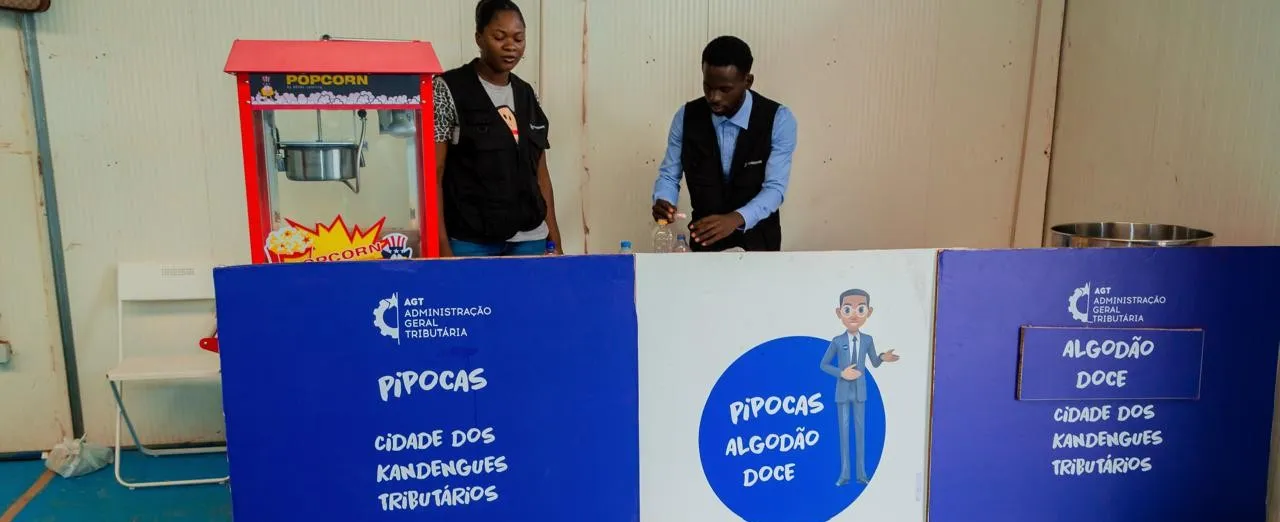
In a country where millions of children go hungry and have no access to school, even a cloud of sugar can provide a way to extract public money. Cotton candy, made mostly of air and sugar, looks more substantial than it is. In AGT’s business dealings, that lightness acquired weight on invoices.
Two Portuguese companies billed In Pressionante Kianda, hired by AGT to stage children’s fairs, €8,033.20 for three cotton candy machines. João dos Santos, then a shareholder and manager of the Angolan company, says he received only one. A separate quotation obtained in Portugal at the time offered a new machine for €300 plus VAT.
Maka Angola’s investigation traces dealings between the tax authority and businesses associated with the Portuguese couple Carla Castelo Trindade and Mário Martins. A lecturer at the Catholic University of Portugal, Carla taught Leiria on his master’s course. The relationship between teacher and student extended into business.
Kianda was incorporated on 7 June 2023. Two Portuguese companies associated with Mário, In Pressionante Unipessoal and In Pressionante 2Win, held 70 per cent. Angolan partners Salvador Pascoal and João dos Santos held 20 and 10 per cent respectively. Carla had also supervised Pascoal’s master’s dissertation. He says the Portuguese couple never paid even the 70,000 kwanzas, then less than €50, corresponding to their stake.
Carla now advises AGT on tax-crime investigations, work for which she billed more than 551 million kwanzas over eighteen months. On 2 September, she organised a seminar on combating fraud, corruption and money laundering for senior officials from the prosecutor general’s office, AGT, the intelligence service and the criminal investigation service.
The irony begins before the Angolan company existed.
Business before incorporation
On 19 April 2023, Carla discussed presenting her husband’s companies to AGT with Leiria. Correspondence reviewed by Maka Angola shows that he had instructed the relevant directors to arrange an online meeting with the couple.
“Did you like the presentation?” she asked. Leiria called it “very interesting” but wanted the Angolan operation highlighted. Carla said it featured in one or two slides: “Since we don’t have any activity yet, I didn’t want too much to be made up.” Kianda would not be incorporated for another seven weeks.
Carla also asked whether Leiria had read her husband’s interview with the Portuguese newspaper Observador. Mário had announced an $8 million investment in Angola and 100 jobs initially.
On 5 May, another company, Made in Luanda, submitted a 72.3 million kwanza proposal to AGT for a children’s fair called Cidade dos Kandengues, or “Children’s City”. It included two minibuses to transport children from schools and 100 snacks a day. On 12 May, AGT sent the proposal to Carla. She turned it into a Kianda proposal for 70 million kwanzas, although Kianda did not yet legally exist.
On 22 May, two weeks before incorporation, Kianda signed a €542,400 contract with In Pressionante Unipessoal for fair production and supplies. Mário, that company’s sole shareholder and manager, signed for the Portuguese supplier. Maria Filipa de Quadros signed as Kianda’s manager. She also held a third of In Pressionante 2Win, which owned 30 per cent of Kianda until November 2024.
Later, through a contested shareholders’ meeting, Mário consolidated the two Portuguese companies’ stakes in Kianda under Unipessoal. The couple then took over Kianda’s management.
On 28 May, Carla was assigning tasks in a WhatsApp group preparing the first fair. She asked her husband to “negotiate seriously” over a bouncy castle and popcorn and cotton candy machines, citing prices of €1,600, €400 and €400 respectively. She considered repeat commissions from AGT highly likely. The equipment could also be reused for Christmas or back-to-school campaigns.
Four days after Kianda’s incorporation, on 11 June, Unipessoal invoiced it for €80,143 in fair supplies. The items included panels, bags, paper cones, wristbands, barriers and wheelchairs. Cotton candy and popcorn machines were not itemised.
The money already had a destination
Kianda’s account at Banco Caixa Angola was opened on 14 June 2023 by its managers, dos Santos and Quadros. According to information gathered by Maka Angola, Quadros had never visited Angola and signed documents in Portugal. Dos Santos says travellers were asked to carry the papers from Lisbon airport to Luanda.
That day, Carla introduced herself to the bank as “one of the people responsible for the company’s finances”. She was not one of its registered managers.
She said Fernando Silva, finance director of the Portuguese Unipessoal, would operate the account and make transfers. “Over the next few days, 70 million kwanzas, around €90,000, will enter the account. However, a payment of around €80,000 needs to be made to Lisbon.” The money had yet to arrive; its intended destination was already clear.
Criminal lawyer Benja Satula told Maka Angola that a bank could be implicated in “financial irregularities and fraud” if it processed payments through people who were neither account signatories nor authorised by power of attorney.
The first fair ran from 16 to 23 June. According to dos Santos, it occupied half the marquee of a restaurant in Talatona, Luanda, including two rented bouncy castles. Kianda had no employees under contract: he handled its daily business and recruited casual workers to assemble the fair.
Accounts gathered by Maka Angola describe early fairs in Luanda, Benguela and Huíla relying on rented cotton candy and popcorn machines. Pascoal says he advanced money for initial expenses, including equipment hire. “The Portuguese partners had not invested even one kwanza in Angola,” he says. Dos Santos secured donated water, biscuits, ice cream and crisps for the children. He says AGT supplied a vehicle for the Benguela and Huíla events because Kianda had no money.
Dos Santos describes work that involved assembling cardboard displays, handing out cotton candy and popcorn, and hiring promotional staff to guide children through the fair. The cardboard “city” was reused at subsequent events.
The official who wanted an accounting
A proposal signed on 15 August 2023 put the cost of the second and third fairs, in Benguela and Huíla, at 70 million kwanzas under a simplified procurement procedure. Reusing the materials prompted questions about what AGT was paying for.
Carla shared messages she had sent Leiria with the Kianda group. “I am starting to get REALLY furious,” she wrote, complaining that AGT’s finance department had asked the local partner for a list of everything produced for the Luanda fair.
Dos Santos says Roberta Malaquias, then an AGT board member, wanted an itemised account of what the authority had already paid for, to prevent it being charged again for the same materials. In the company’s internal correspondence, that demand earned her the label “witch”.
Mário congratulated his wife on negotiating with the female board members: “one a witch and the other super demanding”. Carla wanted the team focused on work, free of “bureaucratic issues”. She regretted sending the materials list and said they had assembled everything without a single email, let alone a signed contract.
In a conversation shared with the group in March 2024, Carla asked Bráulio Assis, then AGT’s communications director, about the award letter. He too called Roberta a “witch”. Carla said the “wicked witch” had harmed them. “I’ve cried so much already,” she added. Bráulio assured her that Nerethz Tati, responsible for AGT’s communications and marketing, would compensate her.
On 26 April 2024, Tati announced approval of the project for AGT’s tenth-anniversary celebrations in messages Carla shared with the group. “Everything went through, Professor. I still can’t believe it,” Tati wrote, promising they would deliver “perfection”.
“Nobody loves me more,” Carla replied. “We’re here hyperventilating.” Tati said she had instructed Bráulio to communicate the decision. “Congratulations to us. Another win.”
Bráulio subsequently put the available budget for the festivities at 182 million kwanzas. Tati is now director general of Angola’s gambling regulator.
In Part II: the company created to “provide an outlet for the Portuguese companies’ products”, invoices issued before contracts, and the fate of the cotton candy machines.
Tweet